A maritime lawyer by profession, sometimes called Frog Prince of the Philippines with currently more than a thousand of collectible frog items. Like the frogs with a reputation for leaping that is well deserved, jump with me to my froglandia as we travel and explore the world seeking symbols of divine powers of love, fertility, regeneration, rebirth, immortality, and transformation.
Saturday, June 4, 2016
Voltes V
Dateline June 4: Voltes V was first broadcasted in Japan by TV Asahi from June 4, 1977 to March 25, 1978
In the Philippines, since May 5, 1978, an English-language dub of Voltes V was first aired on GMA-7, which was shown every Friday (6:00 pm) and lasted for a year until 1979. In 1979, shortly before the series finale, then-president Ferdinand Marcos issued a directive banning Voltes V and other similarly-themed anime series due to concerns about "excessive violence".The directive also led to speculations at the time that the series was also taken off the air due to its aforementioned revolutionary undertones. In 2012, Marcos' son Bongbong defended his father's decision to ban Voltes V, stating that parents before were worried about the excessive violence in the show, so Marcos pulled the show and other robot-based animated series from television to appease their demand
Voltes V has embedded itself in Filipino pop culture. The debut album of the Filipino rock band Eraserheads is titled Ultraelectromagneticpop!, a reference to the "Ultraelectromagnetic Top" used in the series. A thirteen-foot sculpture made by Toym Leon Imao called at the time Last, Lost, Lust for Four Episodes was displayed in front of the Palma Hall at the University of the Philippines Diliman from September 20 to 28, 2014, consisting of brass, fiberglass, and galvanized iron. The sculpture was made to represent "the anger [Imao] felt as a 10-year-old when Voltes V and the other robots were summarily removed from television.
Sunday, March 20, 2016
Capsule Hotel of Tokyo
Tokyo's Capsule Hotel
Tokyo has an unusual hotel to suit every taste, whether you want to spend a night in a pod hotel, at an urban onsen, or stay with a Japanese family.
A capsule hotel (カプセルホテル kapuseru hoteru?) is a type of hotel developed in Japan that features a large number of extremely small "rooms" (capsules) intended to provide cheap, basic overnight accommodation for guests who do not require the services offered by more conventional hotels
The guest room is a modular plastic or fiberglass
block roughly 2 by 1 by 1.25 m (6 ft 7 in by 3 ft 3 in by 4 ft 1 in).
Facilities differ, but most include a television, an electronic console,
and wireless internet
connection. The capsules are stacked side-by-side, two units high, with
steps providing access to the second level rooms, leading to
comparisons to corpse drawers in a morgue.
The open end of the capsule can be closed, for privacy, with a curtain
or a fibreglass door. Luggage is stored in a locker; and washrooms are
communal.Some capsule hotels offer separate sections for male and female guests. Clothes and shoes are sometimes exchanged for a yukata and slippers on entry. A towel may also be provided. The benefit of these hotels is convenience and low price, usually around ¥2000-4000 (USD 19-38) a night. They provide an alternative for those who (especially on weeknights) may be too drunk to return home safely, or too embarrassed to face their spouses
That unique Japanese experience – a night's sleep in a tiny pod – in
the heart of the city. There is very little here to appeal to visitors
other than the novelty of doing something very Japanese, but the shared
facilities, including a bath and sauna, are clean, and there are lockers
for customers carrying a lot of luggage. Be warned – customers include drunk businessmen who have missed their
last train home and are looking for somewhere cheap to stay. Rooms are
cramped at two square meters, and have a television for those unable to
sleep. A basic restaurant in the hotel also offers cheap snacks and
light meals.Saturday, February 6, 2016
Chinese New Year and the Froggies
Kong Hei Fat Choi. 2016 is the Red Fire Monkey year
The foundation of the Chinese Zodiac, also called Chinese Animal Astrology, was from the 12 "Earthly Branches" represented by the 12 animal symbols (The Rat, Ox, Tiger, Rabbit, Dragon, Snake, Horse, Sheep, Monkey, Rooster, Dog, Boar), the five elements (metal, water, wood, fire, and earth) and the Yin-Yang theory.
There are many myths and legends about how the 12 animals representing the 12 years in a lunar cycle came into being. One of the most popular is that the Lord Buddha called all the animals to come to him before departing this earth. Only 12 animals came, and as a reward he named a lunar year after each according to the order in which it arrived. The Rat was the first to get there, crossing the final river on the back of the Ox and jumping down in front. Following them were the Tiger, Rabbit (Hare), Dragon, Snake, Horse, Sheep (Goat, Ram), Monkey, Rooster, Dog, and Boar (Pig).
I was born under the Year of the Dog (1970) – 狗 / 犬 (戌) (Yang, 3rd Trine, Fixed Element Metal):Here is how i was described: Honest, intelligent, straightforward, loyal, sense of justice and fair play, attractive, amicable, unpretentious, sociable, open-minded, idealistic, moralistic, practical, affectionate, sensitive, easy going. Can be cynical, lazy, cold, judgmental, pessimistic, worrier, stubborn, quarrelsome.
To be more specific, i am a metal dog (6 February 1970 – 26 January 1971). In Chinese TaoistMetal attributes are considered to be firmness, rigidity, persistence, strength and determination. The metal person is controlling, ambitious, forceful and set in their ways as metal is very strong; and they are self-reliant and prefer to handle their problems alone. The metal person is also materialistic, business oriented and good at organization and stability. However the metal person can also appreciate luxury and enjoy the good things in life. Just as metal can conduct electricity, the Metal person has strong impulses and generative powers and can bring about changes and transformations for those who come into contact with them. thought,
Sadly speaking, I guess the chinese have forgotten to include Frogs as part of the Chinese Zodiac . Ironically, the Three legged Money Frog, also known as Chan Chu which means frog or toad, is an ancient and popular Chinese symbol for prosperity. It is said to be the bearer of good fortune, which is why you always see them bringing two strings of coins tied behind their back and holding a lucky Ching Dynasty gold coin in their mouth. According to Feng Shui lore, Money Frogs are believed to drive away evil, protect wealth, and increase income.In ancient China, these mythical creatures are said to appear every full moon near homes that will receive good news of increased wealth or monetary gain. Feng Shui Masters believe that Money Frogs go out in the afternoon to collect money and return at night with lots of money sticking on their feet.
Even if the chinese bypassed frogs in the chinese zodiac, at least the world's leading conservationists have together named 2008 "The Year of the Frog," in hopes of raising both awareness and funding needed to mitigate the amphibian extinction crisis. Globally, there are more than 4200 species of frogs, with new species being discovered every year Habitat loss from urbanization, disease, pesticides, poor land management practices, fire suppression, introduced predators and possibly issues associated with global climate change are just some of the causes that have individually or collectively played a part in the localized or range wide declines of many species of frogs.In addition to their pleasant calls, frogs also provide a free pest-control service. Frogs eat billions of harmful insects annually, including mosquitoes and their larvae. In turn, they are a natural food item for many species of reptiles, fish, birds and mammals.
Frogs are one of the best leapers on
the planet! Did you know that frogs can launch themselves over 20
times their own length using those big strong legs of theirs? That
would be like if you could jump 100 feet! Frogs are powerful
jumpers, and the ability to jump is a major factor in frogs'
survival. A frog that can jump far and quickly is more likely to
escape a predator.
Legs :
Frogs do not use their front legs in jumping for anything more than
balance. However, balance is an important part of being able to
jump. A frog's front legs are more useful for propping it up when it
sits.Back Legs :A frog's back legs are what give it power and agility when it jumps. The large, strong muscles of a frog's back legs propel it into the air.
Muscles : A frog needs to have strong, well-developed leg and back muscles in order to jump. The muscles tighten and bunch up like springs just before releasing tension, which causes the frog to spring into the air.
Movement : Frogs jump in zigzag patterns for a couple of reasons. It is distracting and harder for a predator to catch a frog that is moving erratically, and it also helps the frog navigate the terrain it is moving over.
Kung Hii Fatt Choi!
Saturday, September 19, 2015
Heneral Luna and the Gorechos
After watching the much talked film "HENERAL LUNA" , i am posting
this selfie pic as i give salute to Gen. Antonio Luna's statue at the
town plaza of Luna, La Union.
Heneral Luna, directed by Jerrold Tarog and starring John
Arcilla, is about General Antonio Luna’s attempts to lead an
often-fractured early version of the Philippine Army against a superior
American force. Set a few months before his death, the movie explores
Luna’s life, his uncompromising nature, and how his unflinching loyalty
to his vision of what the Philippine Republic should be led to his
downfall.
The film depicts Luna as a deeply
uncompromising man, who believes that Filipinos should start to move
away from petty regionalism and be united. Towards the end of his life,
Antonio Luna declared that the Filipinos’ biggest enemy is not the
Spanish or the Americans, but ourselves
Heneral Luna explores the main character’s faults and use it to
define his story. John Arcilla portrays Antonio Luna as a deeply flawed
man, and the movie never shies away it. He is abrasive, offensive,
arrogantHowever, that arrogance is not just hot air. Luna is a deeply
uncompromising man, who believes that Filipinos should start to move
away from petty regionalism and be united. The movie masterfully shows
both sides of Luna and how each side feeds into the other.
. The area was once called "Namacpacan",
which is an Ilocano word meaning “one who feeds".On 18 October 1906,
during the terms of Governor Joaquin Luna and Mayor Primitivo
Resurrección Novicio, the town was renamed Luna by virtue of Philippine
Commission Act No. 1543 to honour the famous Luna brothers:
Revolutionary General Antonio and Spoliarium painter Juan; their mother,
Doña Laureana Novicio Luna, was a native of Namacpacan.
On September 22, 1892, Juan Luna killed perhaps one of my ascendants, Juliana Gorricho Pardo de Tavera, the mother of Paz Pardo de Tavera (Juan Luna's wife) , Both of them were killed by Juan Luna due to extreme jealousy, a crime of passion they say. I am still doing my research that Gorricho perhaps is a variation of my surname Gorecho. Juliana gave the lamp to Jose Rizal where the paper of "Mi Ultimo Adios" was found.
Labels:
cinema,
film addict,
Heneral Luna,
juan luna,
luna,
movies
Tuesday, September 15, 2015
LESSONS IN HISTORY: THE GREAT LEAN RUN
“The next best thing to being free is the struggle to be free”. A memorable quote from Lean Alejandro, one of the icons of UP Activism.
I was born two years before President Ferdinand E. Marcos placed the Philippines under Martial Law on September 21, 1972, . The declaration issued under Proclamation 1081 suspended the civil rights and imposed military authority in the country. It became unpopular as excesses and human rights abuses by the military emerged. Torture was used in extracting information from their enemies. Martial law was lifted by President Marcos on January 17, 1981. In the following years there was the assassination of Ninoy Aquino in 1983, the Snap Elections of 1986 and the People Power Revolution or EDSA Revolution in 1986 which led to Marcos, with the advice from the U.S. government, left the country and Cory Aquino becoming president.
A notable intellectual and activist who openly criticized the Marcos administration, Lean was killed Sept. 19, 1987. After the failed coup attempt led by Col. Gregorio Honasan, Lean announced plans for a major demonstration against the return to fascism. Returning by car to the headquarters of BAYAN, he was fired upon by a gunman, instantly killing Lean.
Lean
died during my freshman year in UP Diliman. Sad to say, I never
realized his importance that time perhaps due to my personal struggle
or preoccupation to adjust myself with the UP culture. Apolitical
perhaps was the right word that time. Years later, i became part of
SAMASA, a political alliance which in a way became my justification for
using "sandals" or tsinelas during my UP days.
From
1987 to 1991, i became one of the so-called "Iskolar ng Bayan"
as part of the UP Diliman studentry when i took BS. Economics.
Basically, I became attached to my organizations Philippine Collegian or KULE, and SAMASA Alliance .My relatives
and friends usually asked me "bakit ka ba naging aktibista". Perhaps
my answer will be because UP is the perfect place to grow in all aspects,
whether it be politically, socially, etc. Yes, I myself became part of UP
Activisim movement. And i am proud that it made me a better person.
“The
3.7-kilometer run is a special distance experiential run that includes a
especially-designed obstacle course, race, and chase production. It is an
innovative approach to teach lessons to the new generation who has never
experienced martial law. Each participant will experience life under martial
law and step into Lean's slippers,” Atty. Susan Villanueva, Sandigan para sa
Mag-aaral at Sambayanan (Samasa) Alumni Association chairperson, said.
“It
is a celebration of the life of Leandro L. Alejandro, one-time UP student
council chairman, and the most popular youth leader during the turbulent
martial law years,” Villanueva said.
The 3.7-kilometer run starts
at the UP Sunken Garden and covers the entire UP Diliman
Academic Oval and a portion of the University
Avenue . Opening ceremonies will begin at 4:30 pm at the Sunken Garden . The first wave of runners will begin at 5 pm.
The event hashtag is “BeLean,” making the “Great Lean Run” also a call to healthy living
Lean was instrumental
in setting up the UP Samasa student political party, which was active and a key
political force in UP campus politics during the martial law years and beyond. UP Samasa aims to
“re-introduce” Alejandro, his ideals, and his works to the current generation
of student activists through the fun run. It is hoped that Lean will
become an inspiration to the younger generation
Here are some of the famous quotes of Lean:
- “The line of fire is a place of honor”
- "It is in the struggle that we fully realize what it means to be alive, and the more we struggle, the more we see the beauty and profundity of life."
- “I am sure you will agree with me when I say that the greatest adventure on earth today is our struggle for freedom. The pain and the sacrifice are staggering. The battles are historical. And the victory shall be truly glorious indeed.”
Fellow Kule Boying Pimentel said in his article "Lean’s was a short, eventful life, full of meaning and passion. He was the young firebrand who led to us on those many marches on Mendiola toward Malacanang, who led us in defying the brutal dictator. He was the young idealist who risked his life in the quest for meaningful social change and freedom from oppression. He didn’t die.Lean Alejandro lives on.
Participants will
“experience running in Lean’s shoes during the 3.7-kilometer trail, from the UP
Sunken Garden to the UP Academic Oval and back,”
Villanueva said. “Lean continues to be a prime example of how the youth can effect change through critical thought and social involvement."
Each runner will have
to wear a belt with three ribbons: life, liberty, and property. During the run,
elements of an authoritarian regime will try to grab the ribbons from the
participants, as was the practice during Martial Law. Participants are being
challenged to complete the run with at least one ribbon, an indication that he
or she survived the martial law years.
With a registration fee of P350 for students and P800 for non-students, The Great Lean Run is jointly organized by the Samasa Alumni Association and the UP Office of the Vice Chancellor for Student Affairs (UP OVCSA).
For details, please
visit the
Great LEAN Run Facebook page.
Sunday, September 6, 2015
#Kanser @35 the musical
What was i doing when i was 17 years old? I was still enjoying my freshman year in UP Diliman for my B.S. Economics course. And my good friend Jomar Fleras has gained fame as a playwrite for his piece "KANSER".
In an interview by Curtain Call Manila , Jomar narrated " I started writing plays when I was still in high school. I was a Martial Law baby and it was that era when freedom, including free expression was suppressed. But we all had to be creative in bringing the message of the people out there. And so I turned to playwriting as a way to dramatize the plight of our people as well as to use the power of theater in awakening them from apathy and complacency."
Noli Me Tangere is Dr. Jose Rizal’s expose of corrupt friars
from who have made the Catholic religion as instrument for enriching and
perpetuating themselves in power by seeking to mire ignorant Filipinos
in fanaticism and superstition. Instead of teaching Filipinos true
Christianity, according to Rizal; they control the government by
opposing all progress and persecuting members of the ilustrados unless
they make themselves their servile flatterers. The novel lampooned,
caricatured and exposed various elements in the colonial society.
Over the years, this work of fiction have had many
incarnations and considered, as one of its most important versions is
KANSER, which Gantimpala Theater Foundation Inc. produced back in 1979.
In “Kanser (Noli Me Tangere),” Crisostomo Ibarra returns home
after his European studies and rekindles his romance with childhood
sweetheart Maria Clara. His return triggers an old rift with the town
friar, Padre Damaso. As the play progresses, Ibarra realizes that the
malady of oppression and colonial brutality has been killing not only
his town, but his motherland as well.
The Gantimpala Theater Foundation
production of Jose Rizal’s “Noli Me Tangere,” retitled “Kanser” and
written by my good friend Jomar Fleras, has been around for some 35
years now since it was first produced in 1979. “Kanser” is being
reincarnated as a full-length, sung-through musical, with music by Jed
Balsamo.Lead roles are played by singing heartthrob Michael Pangilinan
and Jacob Benedicto as Crisostomo Ibarra, and Myramae Meneses as Maria
Clara. Bodjie Pascua is Pilosopong Tasyo.
"Kanser has always been focused on the discourse between reform
and revolution. My vision of Kanser from the very start is that it
should be able to show parallelisms between the social realities of
Rizal’s era with that of the present." Jomar said. "Kanser has actually evolved into a musical through the years.
Every now and then, we would insert songs and music. And now, it is a
full musical which I believe will be classic on its own. This will be my
legacy and contribution to Philippine theater."
xmas countdown: September 6
xmas countdown: September 6: 109 days to go! Let us always meet each other
with smile, for the smile is the beginning of love.- Mother Teresa
Sunday, August 16, 2015
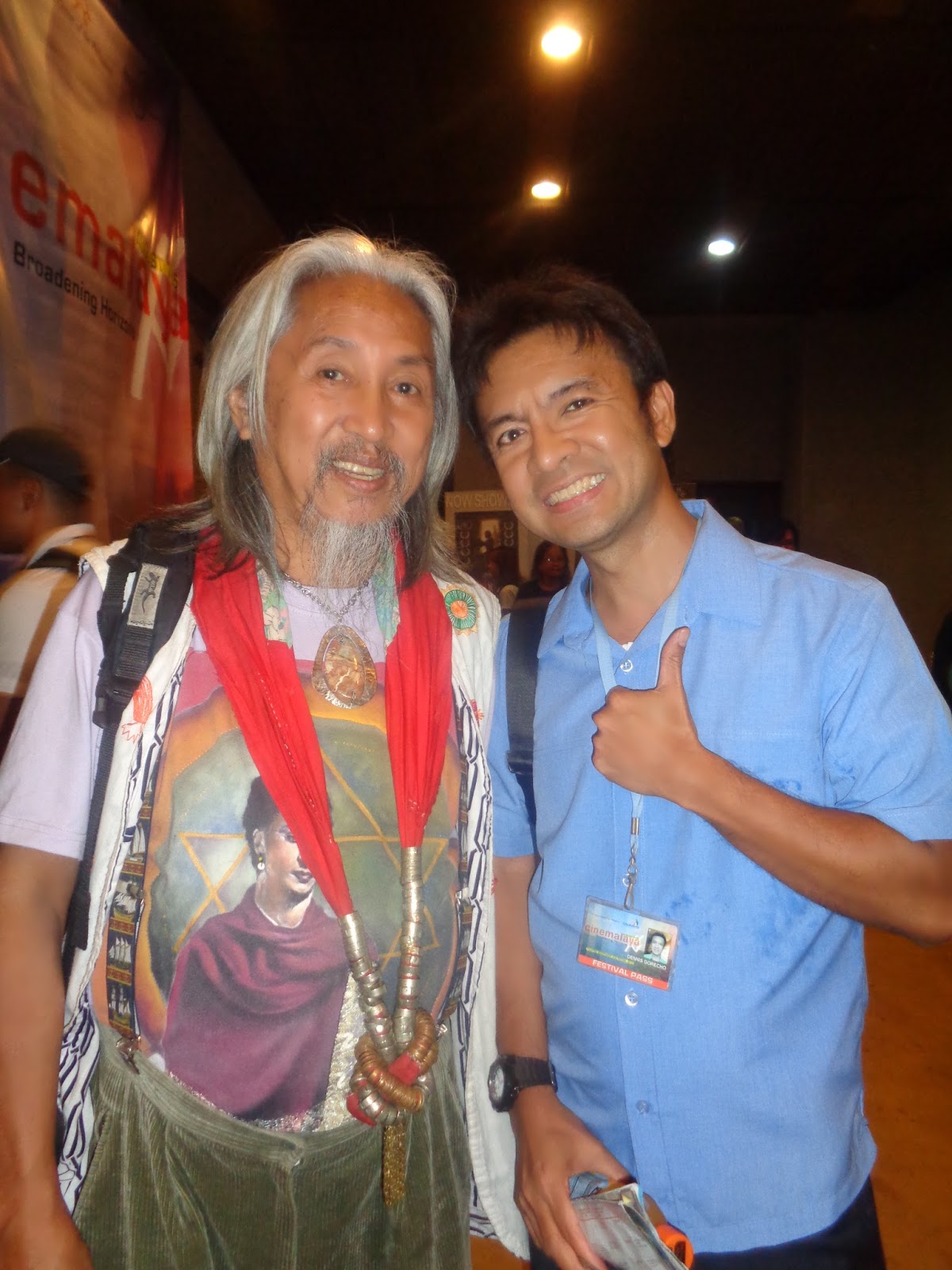
2015 Cinemalaya Film Festival
|
|
This year's competition was only held for the short film category. The winners are:
- Best Screenplay: Papetir
- Audience Choice: Sanctissima
- Best Film: Pusong Bato (Stone Heart)
- Best Direction: Lisyun Qng Geografia (Geography Lessons)
- NETPAC Prize: Wawa
- Special Jury Prize: Wawa
- Apasol (Chasing Sun) by Ryanne Murcia
- Gatilyo ng Baril by Glenmark Doromal and Eero Yves Francisco
- Kyel by Arvin Belarmino
- Lisyun Qng Geografia (Geography Lessons) by Petersen Vargas
- Mater by Annemikami Pablo
- Nenok by Milo Tolentino
- Papetir by Darwin Novicio
- Pusong Bato (Stone Heart) by Martika Ramirez Escobar
- Sanctissima by Kenneth Dagatan
- Wawa by Anj Macalanda
The finalists for the Full-Length Feature category for Cinemalaya 2016 were also announced at the event. These finalists will receive production grants of P700,000 each. The winner of the best film for this category will also receive P250,000. The finalists for Full-Length Feature are:
- Ang Bagong Pamilya Ni Ponching by Inna Salazar and Victor Villanueva
- Ang Mga Bisita ni Mamang by Janice O'Hara and Denise O'Hara
- Dagsin by Atom Magadia
- Hiblang Abo by Ralston Jover
- I America by Ivan Andrew Payawal
- Kusina by David Corpuz and
- Lando at Bugoy by Vic Acedillo, Jr
- Mercury is Mine by Jason Paul Laxamana
- Pamilya Ordinaryo by Eduardo Roy, Jr
- Tuos by Derick Cabrido
Subscribe to:
Posts (Atom)