Sunday, June 19, 2011

Happy Birthday Papa

 If papa  is still alive today, he should have been celebrating his 74th birthday today, August 2. He died at the age of 65 nine years ago, or on November 16,2003.


In my blog “KAMATIS” LOVE AFFAIR OF PONCHING AND LINDA GORECHO I wrote that if I will submit the love story of my parents to “Maalaala Mo Kaya,” I will use the title “Kamatis.” The wedding line, “Till death do us part” will be replaced by “But death will not set us apart.” All throughout their more than thirty years of marriage, we never saw them engage in physical fights. Although we were accustomed to Mama’s masungit and mataray lines, we knew that was just how they expressed their emotions: only through words and eye contact. Laging sinasabi ni Papa: Bago pa man magkasala si mama sa kanya (siguro sa pagiging mataray ni Mama) pinapatawad na nya si mama. If mama was angry, Papa would just step back. Di nya sasalubungin emotion ni mama.

When we were growing up, I remember times when Mama scolded us, “Buti nga kayo di nyo naranasan ang magtinda ng kamatis sa palengke.” Then she would cry. Perhaps, this was her way of saying that whatever the benefits we were enjoying then were due to their hard work..This is something that children have to realize: that parents will sacrifice a lot for the future of the kids. If mama would say the “kamatis” story, Papa, on the other hand, would tell us stories when he was still a security guard in a government agency before they got married in July 1968. Papa was a security guard by day and a student by night taking up library science. When he graduated, he proceeded to be a librarian in the same office until he retired in early 1990s.

People wonder why we have several stuff in our house which Papa did not want to dispose, especially the shoes. Papa justified this by saying that while he was growing up, he never had the luxury of owning new ones since both he and mama came from a family with very modest means. He tried to instill this in us such that long before ukay-ukay became famous, we were already wearing secondhand clothes and shoes, sleeping on beds, sitting on chairs and sofas that papa bought from the secondhand shops in Bangkal. Seldom did we wear brand-new clothes, except maybe during Christmases when our Titas bought us clothing on an installment basis - one Tita would buy us pants while another took care of the shirts. Never mind the shoes, andyan naman ang Bangkal. We became the walking models for ukay-ukay.

 My mother, fondly called Mama Linda, died last year on May 17, 2002 due to pericarditis and lymphoma or cancer of the lymph nodes after almost a month of confinement at the Philippine Heart Center. A year and six months later, my father, Papa Ponching to many, died last year, November 16, 2003 a Sunday, due to pneumonia after being bedridden for almost eight months brought about by complications arising from an operation on his brain (hydrocephalus).

Happy father's day...

Wednesday, June 15, 2011

Gorecho and Jose Rizal


HAPPY BIRTHDAY JOSE RIZAL . Dateline: June 19, 1861. José Protacio Rizal Mercado y Alonso Realonda was born. He was a Filipino polymath, patriot and the most prominent advocate for reform in the Philippines during the Spanish colonial era. He is regarded as the foremost Filipino patriot and is listed as one of the national heroes of the Philippines by the National Heroes Committee. His execution by the Spanish in 1896, a date marked annually as Rizal Day, a Philippine national holiday, was one of the causes of the Philippine Revolution. (note: photo taken at CCP wall)

There is more to every photo than meets the eye. Howie Severino presented  the stories behind these photographs on I-Witness last May 30, 2011  at 11:30 pm after Saksi.

"No Filipino hero of his time was as photographed as Jose Rizal. Each photograph reveals facets of his personality and sheds light on the relationships that were very much a part of who Rizal was. One of these photos is a group photo in Paris from the 1880’s that shows Rizal wearing a mischievous half-smile. Could it be because he was foolishly in love with someone in the picture? But he would soon break her heart and have his own broken too. Also in the picture is Rizal's best friends' sister Paz Pardo de Tavera, who would soon meet a tragic end at the hands of another of Rizal's illustrious amigos. The picture captures the short-lived joy in Rizal's happy-go-lucky life in Paris , before he himself would descend into a chain of sad events."


Photograph Of The Original "Mi Ultimo Adios" There was some argument whether this was the original because as you will note, there were no erasures and the grammar was flawless. It was determined such was Rizal’s concentration in the eve of his death that his writing came straight from his soul.

On the afternoon of Dec. 29, 1896, a day before his execution, Dr. Jose Rizal was visited by his mother, Teodora Alonzo, sisters Lucia, Josefa, Trinidad, Maria and Narcisa, and two nephews. When they took their leave, Rizal told Trinidad in English that there was something in the small alcohol stove (cocinilla), not alcohol lamp (lamparilla). The stove was given to Narcisa by the guard when the party was about to board their carriage in the courtyard. At home, the Rizal ladies recovered from the stove a folded paper. On it was written an unsigned, untitled and undated poem of 14 five-line stanzas. The Rizals reproduced copies of the poem and sent them to Rizal's friends in the country and abroad. In 1897, Mariano Ponce in Hong Kong had the poem printed with the title "Mi Ultimo Pensamiento." Fr. Mariano Dacanay, who received a copy of the poem while a prisoner in Bilibid(jail), published it in the first issue of La Independencia on Sept. 25, 1898 with the title "Ultimo Adios."  The stove was not delivered until after the execution. Rizal needed it to light the room and to be able to write the poem and his other parting words. 

In the I-Witness  documentary titled  "Ang Mahiwagang Ngiti ni Rizal" ,  my good friend Howie Severino reported that the lamp that contained the paper of "MI ULTIMO ADIOS" was given to him by Juliana Gorricho Pardo de  Tavera. He carried with him said lamp until his last breath. Juliana is the mother of Paz Pardo de Tavera who was the wife of Juan Luna, another of Rizal's illustrious amigos,. Paz  and Juliana soon met a tragic end at the hands of  Juan Luna  in the Pardo de Tavera house in Paris.


While in Paris, Rizal described the gorrichos pardo de tavera in  a letter dated January 15, 1886 he wrote to his parents:


"My mode of life doesn't change. Luna and I eat here at the studio and as he has many friends at Paris, families who hold soirées at their homes often invite him. For this reason he eats outside often. The Pardo family who lives here also invites me to eat at their home from time to time. Then Luna, Resurrección, and I go there. On such days we do nothing else but talk about our country -- its likes, food, customs, etc. The family is very amiable. The mother (widow) is a sister of Gorricho and remains very Filipino in everything. Her sons Trinidad and Felix Paredo are both physicians; her daughter Paz speaks French and English and she is very amiable, and also very Filipino. She dresses with much elegance, and in her movements and manner of looking she resembles Sra. Itching. She is beautiful and svelte and it said she is going to marry Luna. She asked me to write something in her album and I wrote the story of the monkey and the turtle with illustrations. The young women in Europe usually have the custom of keeping an album (not of pictures) in which they ask their friends to put there drawings, dedications, verses, etc., etc. and they keep them as souvenirs."

In an Inquirer interview by historian Ambeth Ocampo with former social welfare secretary Mita Pardo de Tavera, she narrated that fateful night:

"I’ve often read that in a fit of jealousy, Luna killed his wife and mother-in-law, but until it was insinuated that it was for unfaithfulness, I had to say what I know of the affair. They [Juliana Gorricho, Paz Pardo de Tavera and little Andres ‘Luling’ Luna] were going down the stairs of the house and they did not tell Luna that they were abandoning him because he was violent. Very violent, like his brother [Antonio] the general who was a killer, [had a] killer’s instinct, and so they were also afraid of this Juan Luna because he also had this killer’s instinct. They were leaving the house, the two brothers Trinidad and Felix, with [their lawyer] Regidor were waiting across the street. When the three were going down the stairs, Luna flew into a rage and tried to stop them, and then he shot them."
Juliana Gorricho vda. de Pardo de Tavera (seated at the center with baby Andrés Luna y Pardo de Tavera) with María de la Paz Pardo de Tavera y Gorricho de Luna (standing 2nd from the right) and José Rizal (standing 2nd from the left)
The alcohol lamp [food warmer] that concealed Rizal's Mi Ultimo Adios

Though Juliana's surname is spelled "GORRICHO", there is a possibility that my surname is related to her though mine is spelled as "GORECHO". I have also encountered persons carrying another variation of my surname which is "GORICHO".
We are now  embarking into an illustrious endeavor to document the Familia Gorecho of  Matabao, Tubigon,Bohol.Perhaps, if preparations and coordination will be successful, a grand clan reunion can be organized soon.The Gorecho Family Tree will be an updated database on the members of the Gorecho Clan that originated from the matrimonial bondage of Isidro Gorecho and Tomasa Cristobal. I am now in the process of documenting eight (8) generations of Gorechos.  Out of this matrimonial bondage are three siblings: Alejandro Gorecho, Melchora Gorecho and Joseph Gorecho. Alejandro was married to Barbara Bulahao with six children, Melchora was married to Pedro Mascarinas while Joseph was married to Irenea Estabaya. Thus, there are eighteen (18)   major lines : Six for Alejandro Gorecho and Barbara Bulahao (Librada, Leopoldo, Benegilda , Victoria , Victor, and Gregorio), seven  for Melchora Gorecho and Pedro Mascarinas (Segunda, Enrique, Seferino, Florencio, Felis, Herminigilda and Isidra), and five for Joseph Gorecho and Irenea Estabaya (Constancio, Eusebio, Eulogio, Teofilo, and Juanita).   


For the complete Family Tree, please see http://kapitankokak.blogspot.com/search/label/family%20tree


It is interesting to note that surnames seems to re-appear in other lines (like Gorecho-Mante, Mante-Gorecho, Gorecho-Corpuz, Gorecho-Embradora, Embradora-Gorecho) signifying intermarriage between not-so distant relatives, a typical occurrence in the provincial set-up. 


To review your Philippine History , the filipinos were forced to change the surnames during the Spanish era as a means of population control, or a zoning scheme to determine your place of origin. On November 21, 1849 Governor General Narciso Clavería ordered a systematic distribution of family names for the natives to use. The Catalogo Alfabetico de Apellidos was produced and approved names were assigned to families in all towns. The book itself consists of 141 pages. The  surnames are arranged in 6 columns with at most 72 surnames per column. Despite the title, the surnames are not strictly listed alphabetically (after Gandain is Ganavacas then Gandoy, and Balledor is listed under "V"). All of the letters of the Spanish alphabet are represented except for the letters "I" (in the Spanish orthography of the time "Y" was used instead of an initial "I"), "K" and "W" (there are no Spanish surnames starting with these letters) and "X" (due to a consonant shift, earlier surnames like Ximénez were spelled Jiménez, with a J, by that time.) Name distribution was so systematic that civil servants assigned family names in alphabetical order causing some small towns with only a few families to end up with all names starting with the same letter. Since there are potentially at most 61,000 surnames in the book, not all of the surnames were used..

However, when i checked the said list, the surname "gorecho" or any of its variation are not included in said list. Perhaps, it came from a Spaniard who settled in the Philippines  since  Gorecho/ Gorricho/ Goricho  is a Galician surname meaning it was patterned from the inhabitants of Galicia , Spain. It  is an autonomous community in northwest Spain., bordered by Portugal to the south, the Spanish regions of Castile and León and Asturias to the east, the Atlantic Ocean to the west, and the Bay of Biscay to the north.The name Galicia comes from the Latin name Gallaecia, associated with the name of the ancient Celtic tribe that resided north of the Douro river, the Gallaeci or Callaeci in Latin, and Kallaikói (καλλαικoι) in Greek (as mentioned by Herodotus). According to Ptolemy, these Callaeci were the first tribe in the area to battle the invading Romans.


Saturday, June 4, 2011

annulment vs. divorce


The debate on legalizing divorce took a kick-start when news of Maltese referendum favoring divorce reached the Philippines a few days ago. This has prompted progressive groups to make a bolder call for the country to follow in Malta's steps and legalize divorce in a predominantly Catholic nation.

In House Bil 1799, which is proposed by the GABRIELA Partylist,  they argued in essence,  the philosophy behind the divorce bill in the following manner:   :

"Underpinning this proposal is a commitment to the policy of the State to protect and strengthen marriage and the family as basic social institutions, to value the dignity of every human person, to guarantee full respect for human rights, and to ensure the fundamental equality before the law of women and men .. Given realities, couples must have the option to avail of remedies that will pave the way for the attainment of their full human development and self- fulfillment and the protection of their human rights. Existing laws are not enough to guarantee and protect these rights. .. The sanctity of marriage is not based on the number of marriages existing but on the quality of marital relationships. When a marriage is no longer viable, divorce should be an option."
Under this bill, the grounds for filing divorce are , among others, a.

a.       a. when the petitioner has been separated de facto (in fact) from his or her spouse for at least five years at the time of the filing of the petition and reconciliation is highly improbable,
b.      b. when the petitioner has been legally separated from his or her spouse for at least two years at the time of the filing of the petition and reconciliation is highly improbable
c.       c. when the spouses suffer from irreconcilable differences that have caused the irreparable breakdown of the marriage
d.      d. when one or both spouses are psychologically incapacitated to comply with the essential marital obligations.
It must be understood however that divorce in the legal parlance, is the dissolution of marriage for whatever reason resulting in capacitating both parties to remarry.  Divorce legally recognizes that a marriage actually existed, but for whatever reason, one or both parties can no longer continue with the commitment.


On the other hand, for a marriage solemnized in the Philippines to be terminated is, however, not called divorce, it is called an annulment.  An annulment unlike a divorce has the effect of considering the marriage as “void ab initio”, a latin term to meaning the marriage NEVER existed at all.  The grounds for annulment are often pertaining to the absence of, or defect in, one of the essential or formal requisites of marriage. Although it has a different effect in how it considers the marriage (null and void) after annulment, it has however the same effect in terms of capacitating the parties to remarry. It should be noted that for a marriage to take place, there are essential requisites and formal requisites which must first be met.
The essential requisites of marriage are: 1) legal capacity of the contracting party, who must be male and female, and 2) consent freely given in the presence of the solemnizing officer (Article 2, Family Code [FC]).  The formal requisites of marriage are (1) authority of the solemnizing officer, (2) a valid marriage license (except in specific instances mentioned under Chapter 2 of the Family Code), and (3) a marriage ceremony which takes place with both of the contracting parties appearing before the solemnizing officer and declaring that they take each other as husband and wife in the presence of not less than two witnesses of legal age. (Article 3, FC).
Although many loosely call all actions for terminating marriage in the Philippines as annulment, the truth is there are several actions that may be instituted to terminate the marriage.
Declaration of Nullity of Marriage
Grounds rendering a marriage “void ab initio” are:
  1. those contracted by any party below 18 even with the consent of parents
    or guardians;
  2. those solemnized by any person not legally authorized to perform marriage unless either or both parties believed in good faith that the solemnizing officer had the legal authority to do so;
  3. those solemnized without a marriage license except those expresslyexempted by law to secure a marriage license;
  4. those bigamous or polygamous marriages;
  5. those contracted through mistake of one of the contracting parties as to the identity of the other;
  6. incestuous marriages as defined in Article 37 of the FC; and
  7. void marriages by reason of public policy (i.e. between step-parents and step-children, between adopting parent and adopted child).
An action for the declaration of the absolute nullity of marriage may be instituted at any time and shall not prescribe (Art. 39, FC).
It must be emphasized that although the marriage is void from the beginning, a party cannot unilaterally contract a subsequent marriage with the thought in mind that the previous marriage was invalid.  For example, A and B contracted a marriage with a fake marriage license.  Spouse B who knew that the marriage license was fake contracted a second marriage with C.  Is the marriage between Spouse B and C valid? No!  The marriage between A and B should have first been declared null and void by the Court before Spouse B and C can marry.
Annulment of Marriage
In an Action for Annulment of Marriage, the following marriages may be annulled:
  1. that the party in whose behalf it is sought to have the marriage annulled was eighteen years of age or over, but below twenty-one, and the marriage was solemnized without the consent of the parents, guardian or person having substitute parental authority over the party, in that order, unless after attaining the age of twenty-one, such party freely cohabited with the other and both lived together as husband and wife;
  2. that either party was of unsound mind, unless such party after coming to reason, freely cohabited with the other as husband and wife;
  3. that the consent of either party was obtained by fraud, unless such party
    afterwards, with full knowledge of the facts constituting the fraud, freely
    cohabited with the other as husband and wife;
  4. that the consent of either party was obtained by force, intimidation or undue influence, unless the same having disappeared or ceased, such party thereafter freely cohabited with the other as husband and wife;
  5. that either party was physically incapable of consummating the marriage with the other, and such incapacity continues and appears to be incurable; or
  6. that either party was afflicted with a sexually-transmissible disease found to be serious and appears to be incurable.
 Unlike in the first set of grounds above mentioned, an action for the annulment of marriage prescribes; in case of lack of consent, until the party filing for annulment reaches 21;  in case of insanity until the death of either party or the lucid interval of the insane spouse; in case of fraud, force, intimidation or undue influence, incapacity to consummate the marriage or knowledge of the sexually-transmissible disease, within five years from the occurrence of the fraud, force, intimidation or undue influence, incapacity to consummate the marriage or knowledge of the sexually-transmissible disease.


For couples desperate to find a way out of their troubled marriages, annulment is a trying and tedious legal process. Aside from being weighed down by the difficulty of proving the psychological incapacity of either spouse, they also have to incur many expenses: the cost of litigation, filing fees, and even the professional fees of psychologists and psychiatrists.
Bayan Muna proposed House Bill 3952, "An Act Recognizing Spousal Violence, Infidelity and Abandonment as Presumptive Psychological Incapacity Constituting a Ground for the Annulment of Marriage", hopes to make annulment more accessible even to poor couples and seeks to simplify the annulment process, offers couples an easier and less expensive way out.


Under HB 3952, infidelity, abandonment or spousal violence are presumed indications of psychological incapacity. In effect, psychological incapacity would be easier to prove, and the annulment process would take less time and money to complete. Under the measure, adding the presumption of psychological incapacity under Article 36 would reduce the length of the proceedings, and cut expenses like professional fees for psychiatrists or psychologists.

Saturday, May 28, 2011

Taiwan OFWs and their legal rights

May, 2011. Changhua, Taiwan -  I spent my last day in Taiwan with our Filipino Overseas Filipino Workers (OFWs). I attended the Sunday masses twice that day wherein Filipinos usually attend the regular sunday masses in a  church in Changhua. I even became a reader as requested by Fr. Loloy Nespiere of the Apostleship of the Seas (AOS).
Fr. Loloy jokingly  commented that the church could have been "fullpacked" if not for the fact that it is the payday weekend, so most OFWs are in Taichung "shopping."

Based on Philippine Overseas Employment Administration (POEA) 2009 records, Taiwan was third largest Asian destination for OFW. As of 2009, there are 33,751 overseas Filipino workers (OFWs) working in Taiwan. out of t he total 260,995 landbased  OFWs in Asia. The OFWs from Taiwan came from companies of that country’s electronics, metal workers, and semi-conductor industries,

However, due to the recent global economic recession,  remittances from Filipinos in Taiwan dropped sharply by 52.71% in 2009 as  lay-offs were implemented due to the filing for bankruptcy of these companies and retrenchment of workers.The Philippines received about US$92 million from Filipinos in Taiwan in 2009 compared to the US$194.071 million received in 2008.


I delivered the paralegal lecture on the OFW legal rights twice, one  in the afternoon and one during the evening mass. I explained  to them, in essence, the substance of the amended  Filipino Migrant Workers Act.' An essential feature of the amended law is the insurance requirement  that was introduced by the Philippine government and took effect on November 8 last year. The act applies to all categories of OFWs who are hired by agencies and who are leaving the country for the first time. It also applies to workers hired with new contracts by agencies. The insurance policy covers natural and accidental death and permanent disability, repatriation costs, medical repatriation and three months’ salary for every year of the migrant worker’s contract for cash claims that arise from the employer’s liability, among other benefits.

 Last february 2011, friction erupted between taiwan and philippines due to the  Philippine government’s "deportation mess"  of 14 Taiwanese to China. the Philippine government allegedly ignored its request to deport toTaiwan 14 Taiwanese suspected of defrauding several Chinese of $20 million. MECO expressed regret over the Philippine government’s deportation of the 14 Taiwanese to China stressing that the decision to deport the Taiwanese to China was based on the government’s one-China policy.
In the event the fiasco was not resolved, it was feared that the country stands to lose some 600 million Taiwan dollars or roughly P900 million in yearly remittances from Taiwan-based OFWs.

The government does not directly deal with Taiwan, especially on political matters, but only on trade and economics.  


Saturday, May 14, 2011

happy birthday mama

 Mama should have turned 71 this month , May 14, 2012. It was ten years ago when we were able to greet her for the last time a  Happy Birthday as well as Happy Mother's Day.
My mother, fondly called Mama Linda, died  on May 17, 2002 due to pericarditis and lymphoma or cancer of the lymph nodes after almost a month of confinement at the Philippine Heart Center. and three days after she celebrated her 61st birthday.On April 14, 2003, papa  was rushed to Las Piñas City Medical Center after falling down from the stairs — a day short of the one full year from mama’s hospitalization. A year and six months after mama’s death, my father, Papa Ponching to many, died  November 16, 2003 a Sunday, due to pneumonia after being bedridden for almost eight months brought about by complications arising from an operation on his brain (hydrocephalus). I have told relatives and friends that  Papa could have been dead during the second week of April due to the gravity of the hydrocephalus  if not for that incident when he fell from our stairs. Maybe Mama pushed him so that the hydrocephalus and tumor could be detected.

In my blog KAMATIS” LOVE AFFAIR OF PONCHING AND LINDA GORECHO I wrote that if I will submit the love story of my parents to “Maalaala Mo Kaya,” I will use the title “Kamatis.” The wedding line, “Till death do us part” will be replaced by “But death will not set us apart.” All throughout their more than thirty years of marriage, we never saw them engage in physical fights. Although we were accustomed to Mama’s masungit and mataray lines, we knew that was just how they expressed their emotions: only through words and eye contact. Laging sinasabi ni Papa: Bago pa man magkasala si mama sa kanya (siguro sa pagiging mataray ni Mama) pinapatawad na nya si mama. If mama was angry, Papa would just step back. Di nya sasalubungin emotion ni mama.

They have a reverse role: Mama took care of the financial well-being of the family while papa was in charge of the spiritual and emotional needs of the children. Mama was the breadwinner and Papa was the house caretaker. 

When we were growing up, I remember times when Mama scolded us, “Buti nga kayo di nyo naranasan ang magtinda ng kamatis sa palengke.” Then she would cry. Perhaps, this was her way of saying that whatever the benefits we were enjoying then were due to their hard work..This is something that children have to realize: that parents will sacrifice a lot for the future of the kids. If mama would say the “kamatis” story, Papa, on the other hand, would tell us stories when he was still a security guard in a government agency before they got married in July 1968. Papa was a security guard by day and a student by night taking up library science. When he graduated, he proceeded to be a librarian in the same office until he retired in early 1990s

 We did not have money but we had the respect of people, especially the fact that two of their sons entered the priesthood, Fr. Philip and Bro. Stephen. At first Mama could not accept the fact that two sons chose to serve the lord but later realized, according to Papa, that they gave up two sons but regained the whole religious order as their new sons and daughters. Tuwang-tuwa sya pag tinatawag sila na Papa and Mama Gorecho. They had five sons and one daughter, two entered the priesthood, i became a lawyer and the other son went into photography, the business which Papa engaged into while he was alive.


As a young kid, I fondly remember that we were always waiting for her birthday since it was also the summer outing of the reyes clan that usualy coincide with the company outing of RICEL, the export company of her sister, our Tita Elsa Parreno. We had several pictures of beacheneering then with my cousins and titas/titos. Smiles, laughters, stories over somewhat endless food. And of course, the mahjong set will not be absent.

I belong to the more than 40 “apos’ or grandchildren of Damaso and Maria Reyes. I never met my lolo who died before I was born but his absence was greatly compensated by the love and caring that Lola Maria has given to her grandchildren. Their children (Mario, Bert, Odol, Elsa, Julieta, Linda, Malou, Elvie, Mel, and Tita) followed the proverbial phrase “ go and multiply” thus out we came, the 40 plus grandchildren.

  happy birthday mama! Happy Mother's Day!

Saturday, May 7, 2011

Happy Mother's Day

 If your mom is still alive, greet her "Happy Mother's Day." You are still lucky since you can say that to her. For me, the last time i had the chance to say that to her personally was  May 2002, almost nine years ago a few days she left us. At present, i go to Manila Memorial Park almost every other week to visit mama and papa after attending mass in the park's chapel. 


My mother, fondly called Mama Linda, died l on May 17, 2002 due to pericarditis and lymphoma or cancer of the lymph nodes after almost a month of confinement at the Philippine Heart Center. and three days after she celebrated her 61st birthday.On April 14, 2003, papa  was rushed to Las Piñas City Medical Center after falling down from the stairs — a day short of the one full year from mama’s hospitalization. A year and six months after mama’s death, my father, Papa Ponching to many, died  November 16, 2003 a Sunday, due to pneumonia after being bedridden for almost eight months brought about by complications arising from an operation on his brain (hydrocephalus). I have told relatives and friends that  Papa could have been dead during the second week of April due to the gravity of the hydrocephalus  if not for that incident when he fell from our stairs. Maybe Mama pushed him so that the hydrocephalus and tumor could be detected.

In my blog “KAMATIS” LOVE AFFAIR OF PONCHING AND LINDA GORECHO I wrote that if I will submit the love story of my parents to “Maalaala Mo Kaya,” I will use the title “Kamatis.” The wedding line, “Till death do us part” will be replaced by “But death will not set us apart.” All throughout their more than thirty years of marriage, we never saw them engage in physical fights. Although we were accustomed to Mama’s masungit and mataray lines, we knew that was just how they expressed their emotions: only through words and eye contact. Laging sinasabi ni Papa: Bago pa man magkasala si mama sa kanya (siguro sa pagiging mataray ni Mama) pinapatawad na nya si mama. If mama was angry, Papa would just step back. Di nya sasalubungin emotion ni mama.

They have a reverse role: Mama took care of the financial well-being of the family while papa was in charge of the spiritual and emotional needs of the children. Mama was the breadwinner and Papa was the house caretaker. 

When we were growing up, I remember times when Mama scolded us, “Buti nga kayo di nyo naranasan ang magtinda ng kamatis sa palengke.” Then she would cry. Perhaps, this was her way of saying that whatever the benefits we were enjoying then were due to their hard work..This is something that children have to realize: that parents will sacrifice a lot for the future of the kids. If mama would say the “kamatis” story, Papa, on the other hand, would tell us stories when he was still a security guard in a government agency before they got married in July 1968. Papa was a security guard by day and a student by night taking up library science. When he graduated, he proceeded to be a librarian in the same office until he retired in early 1990s

 We did not have money but we had the respect of people, especially the fact that two of their sons entered the priesthood, Fr. Philip and Bro. Stephen. At first Mama could not accept the fact that two sons chose to serve the lord but later realized, according to Papa, that they gave up two sons but regained the whole religious order as their new sons and daughters. Tuwang-tuwa sya pag tinatawag sila na Papa and Mama Gorecho. They had five sons and one daughter, two enterered the priesthood, i became a lawyer and the other son went into photography, the business which Papa engaged into while he was alive.


 Mother's day usually fall within the week of my mama's birthday. As a young kid, I fondly remember that we were always waiting for her birthday since it was also the summer outing of the reyes clan that usualy coincide with the company outing of RICEL, the export company of her sister, our Tita Elsa Parreno. We had several pictures of beacheneering then with my cousins and titas/titos. Smiles, laughters, stories over somewhat endless food. And of course, the mahjong set will not be absent.

I belong to the more than 40 “apos’ or grandchildren of Damaso and Maria Reyes. I never met my lolo who died before I was born but his absence was greatly compensated by the love and caring that Lola Maria has given to her grandchildren. Their children (Mario, Bert, Odol, Elsa, Julieta, Linda, Malou, Elvie, Mel, and Tita) followed the proverbial phrase “ go and multiply” thus out we came, the 40 plus grandchildren.


 What are the philosophical underpinnings of mother's day?

  Ancient Greece imported the Mother Goddess cult from Asia Minor, in the form of a festival to Cybele, a great mother of Greek gods. It was held around the Vernal Equinox around Asia Minor. Originally they identified Cybele with Rhea, the mother of gods. The details were not recorded, and we only know that the goddess was attended by galli
Ancient Romans appropriated the cult to Cybele/Rhea in order to absorb culturally the Greeks and the habitants of Asia Minor, honoring Cybele in the Hilaria festivals, from the Ides of March (15 March) to 18 March. But the Romans were horrified by the Greek celebrations; they quickly associated the cult to the Roman version of Cybele and they made up their own customs.They also made a separate festival in April dedicated to Magna Deorum Mater Idaea, a version of Cybele that was even further separated from Greek customs.The two goddesses, Cybele and Mater Idaea, were eventually merged into a single entity that was completely Romanized, although they kept using galli.


The festivals of Cybele evolved into the Christian festival of Mothering Sunday, honouring the Virgin Mary and your mother church (the main church of the area) It's now a long standing tradition, part of the liturgical calendar in several Christian denominations, including Anglicans, and in the Catholic calendar it is marked as Laetare Sunday, the fourth Sunday in Lent. Children and young people who were "in service" (servants in richer households) were given a day off on that date so they could visit their families (or, originally, return to their "mother" church). The children would pick wild flowers along the way to place them in the church or to give them to their mothers as gifts. Eventually, the religious tradition evolved into a secular tradition of giving gifts to mothers.This festival survived in the UK and Ireland for longer than in other European countries, and it was repopularised in the 20th Century. Most people are unaware of its historical origins, and regard Mothering Sunday and Mother's Day as the one and same festival.

Happy mother's day!!!


i miss my lola maria

I miss my LOLA MARIA…..

This is how I felt after I watched "LOLA” again in Viva Cinema cable channel. I  first saw it at the FEU last year. It was again shown at the  Italian film festival at Greenbelt. It is a digital film of Brillante Mendoza that tackles the story of two elderly women who will do everything for the sake of their love ones as one will be the suspect and the other one will be a victim.

Lola tells the parallel stories of two elderly women, Puring (Rustica Carpio) and Sepa (Anita Linda). Driven by selfless love, the two scrape the bottom of the barrel to raise funds for their respective grandsons. Sepa wants her dead grandson to have a decent burial despite barely having enough to get by in life decently. Meanwhile, Puring wants to free her grandson after he is incarcerated for killing Sepa's grandson. After “pawning”their remaining properties, she gave lola Sepa P50,000.00 as some sort of “blood money.”


Although the film was identified with the great actress Anita Linda, I had the impression that she was somewhat “overshadowed” by the other lola in the film, Rustica Carpio.


The film is not easy to shoot, I guess. Imagine scenes where frail grandmothers were drenched in rainwater as they individually attempt to seek financial help from other people—they turn to neighbors, city officials, and even lending institutions. In the film's most beautifully shot sequence, the funeral procession for Sepa's grandson goes on not with a motorcade but with a handful of boats. The white casket is decorated with colorful flowers that contrast with the bleak surroundings. After a long struggle, Sepa and her family take their beloved dead to his final resting place.

Rustica doesn’t mind being second fiddle to veteran and awarded star Mona Liza. The role was initially offered to Mona Liza but she suddenly suffered a stroke. She was already in a wheelchair. She’s also a noted stage actress, playwright, researcher, book author and one time member of the Movie and Television Review and Classification Board during the Ramos administration.

Again, I miss my lola Maria. I belong to the more than 40 “apos’ or grandchildren of Damaso and Maria Reyes. I never met my lolo who died before I was born but his absence was greatly compensated by the love and caring that Lola Maria has given to her grandchildren. Their children (Mario, Bert, Odol, Elsa, Julieta, Linda, Malou, Elvie, Mel, and Tita) followed the proverbial phrase “ go and multiply” thus out we came, the 40 plus grandchildren.

My recollections of Lola Maria includes the following (a).the Alhambra cigar which she smoked “baligtad” the lighted side was inside her mouth (b) making sampaguita necklaces from her garden (c) she will measure our feet by drawing a sketch of the feet’s outline for our sandals.

We were told that she was really pretty during her younger years. She was even crowned as “Miss Baliwag.”

I think Lola Maria died when I was still in my elementary years. Nevertheless, her love still reverberates until this time amongst her reyes descendants.

Thursday, May 5, 2011

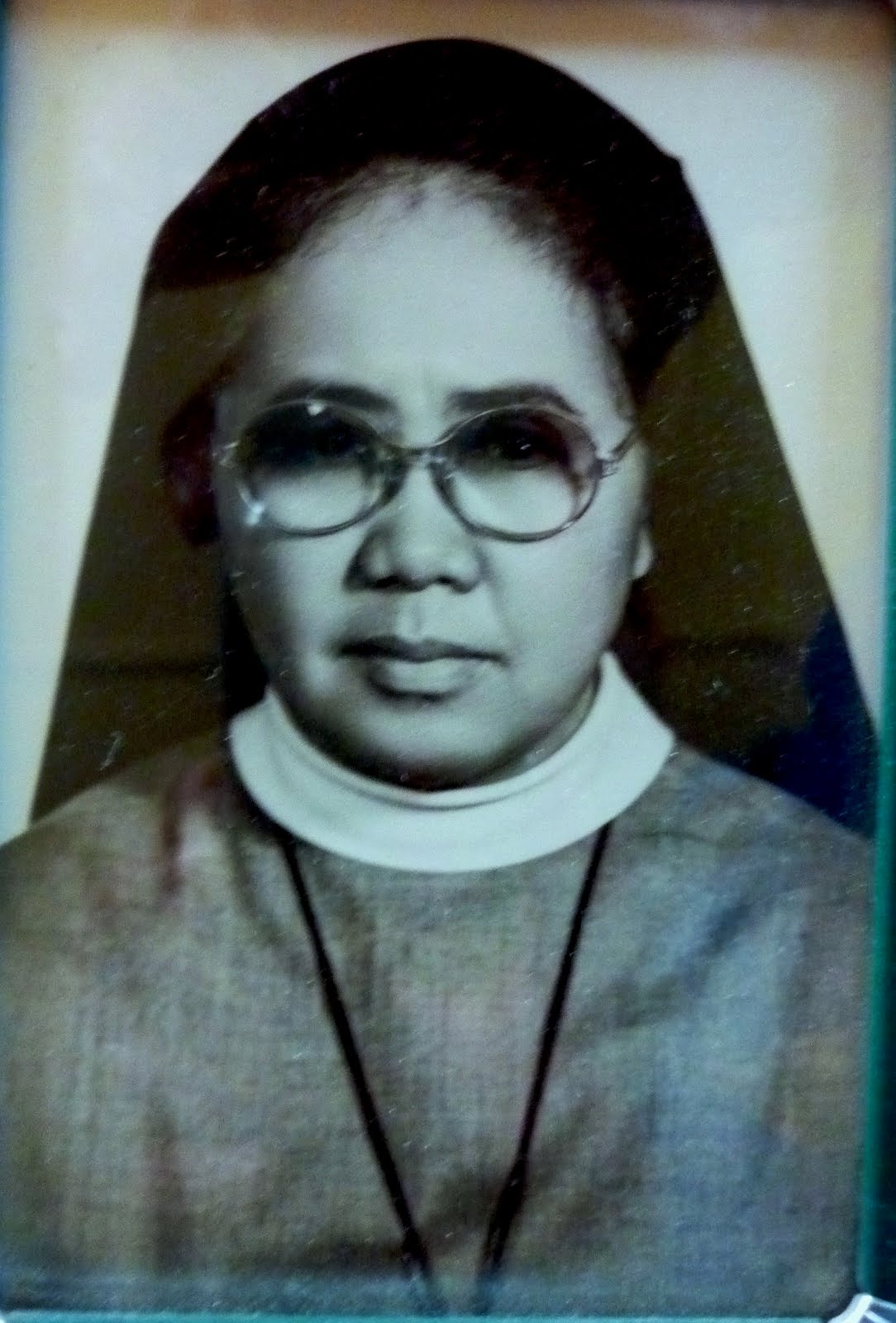
Speech of Sis. Annie Balatayo

 Speech of Sister Annie Balatayo during the SCPS 2011 Alumni Homecoming, April 30, 2011, SCPS grounds Pasay City. She was directress in the early til mid 80s.


Good evening.   Alleluia to all!.  It is difficult to put into words what my heart wish to say to you this evening.  Only the Lord, will be able to comprehend this feeling of mime at the moment.   As the saying goes: “when the heart is full, the mouth is silent”.  I am in this predicament now.  However, it would be against the norm for this activity to keep my mouth closed.    Allow me then to say anything under the stars for the purpose of this occasion.

            I am very happy.  Extremely very happy indeed.  Your initiative is allowing this occasion to happen, for us to come together again, on Easter Season 2011, is overwhelming.  We would sing alleluia to the Lord, for the wonders he has done for us.  Praise the Lord.  What shall we say to the Lord at this point in time, “SALAMAT PO PANGINOON”.  The main purpose of having reunion is to give thanks to God for all the blessings He has poured upon us through the years, successes and gift of ourselves.  We should all rejoice and make this occasion a happy and an unforgettable even in our life.  And please be reminded that we should not only give praise to God for our triumphs in life, but also for the pains and trials we have encountered.  All joys and sufferings in life are blessings from the good Lord.  Naniniwala ba kayo dian?

Reflections taken from the feast of the Anunciation:

            Many things that happen to us are announcements from God, telling us He is involved in our lives and cares for us.  Many events bear God’s fingerprints.  Everything that comes into our lives has meaning and purpose, and can be understood in the life of faith.  It depends on how open we are to the spirit, how willing we are to see God’s bigger plan, and how humble we are to notice it.  Maganda diba?  It effaces heavy hearts and joy takes over.  Food for our souls.  Baon ninyo yan ha?

When my Mother
General told me I would assigned here in Santa Clara Parish School, my instant gesture was, “ayaw ko”.  All boys, what will I do with these boys, I am not trained to handle boys”.  It was almost at the same time I was pulled out from Pagadian City, was involved in community organizing on one of the remote barrios there.  I encountered NPA supporters in his area.  As soon as, Mother Josefina, (my general at that time, may se rest in peace) notice my negative gesture, spontaneously she told me on the spot in her office,  “kaya mo man ang NPA-bakit ang mga boys sa Pasay, napatawa ako, at na challenge ako.  Kaya from her office, I packed my things for St. Mary’s Pasay Community, to report to Santa Clara the following day.  What made happy when I entered here, the students were very happy for the first time, may MADRE sa Santa Clara Parish School.  Ako na ang muse.  Nainggit ang iba sa inyo.  Hehe!  The students welcome me and how they did  it, by going to my office in groups or individually.  The students and I had so many underground secrets and movements.
In spite of the odds in those days, hindi ako nag  give up , almost 4 years ako dito.  In fact, ayaw ko ng umalis, if not obedience – my vow.  Grabe and story of love naming ditto makulay.  The teachers and personnel learned to like me after 2-1/2 years.  This is understandable – adjustment is a long process.  All these happenings inspired me during my stay with you.  Many things that happen to us are announcements from God, telling us he is involved in our lives and cares for us.  Many events bear God’s fingerprints.  Everything that comes to our lives has meaning and purpose and an be understood in the life of faith.  It just depends on how open we are to the Spirit, how willing we are to see God’s bigger plan, and how humble we are to notice it.  See the realization.,

            My greatest advantage as far as intimacy is concerned, I had two (2) jobs in the school.  Directress and Christian Living Teacher for the 3rd and 4th years class.  It was quite a heavy bag on my shoulders, but I had to do this because no lay Christian living teacher would handle the higher years.  This arrangement was again a contributing factor in my closessness with the students.  It was a blessing in disguise.  Our negative experiences in your Alma Mater were a learning process.  We were teching each other in the journey.  I learn from you and you also learn from me.  Our journey was full of pains and joys, kaya matinik at Masaya talagang samahan, the reason for after sometime, missing each other.  I know some of you missed me a lot.  Naniniwala ba kaio diyan?  The graduating class that time were very much involved and affected by the signs of the times.  We became tight to each other in principle because of the events that went through in the journey to wholeness. Hindi ba malaking inspirasyon yan? Salamat, before I left, there were signs of improved camaraderie.

            Marami pa ang mga inspirational instances, but you know recalling stories in the past knows no end.  No amount of time can accommodate stories of the past.  It continues to pop up and becomes more interesting as we go on.  We shall never be able to this – limited time we have.  Important is to realize and remember that we have been together once in a lifetime and we tried our best to become an inspiration to each other for better or for worst till we meet again tonight.  Le us continue to praise God for what has been and will be – Santa Clara will stand forever in our hearts.

            We should acknowledge that the most significant inspiration for us all is the fact, until up to this time, the RVM Sister are still herein your beloved Alma Mater, to continue the ministry of education entrusted to them in this institution.  Le us give them a warm of applause.